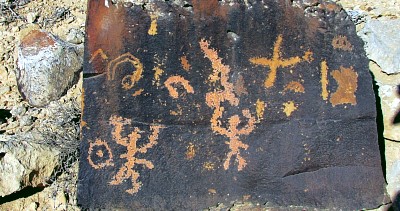
The Negev engravings are a record of cosmological beliefs.
The Negev Desert contains one of the largest and least interpreted bodies of rock art in the Near East. Thousands of petroglyphs, engraved over more than two millennia, have long resisted systematic interpretation. The problem is not a shortage of material. It is a shortage of method.
The dominant assumption — that rock art records daily life, hunting, and herding — leaves most of the Negev corpus unexplained. Under that framework, an ibex is a hunted animal and a boat is a boat. But it cannot account for the patterns that a different approach reveals: compositions that repeat across hundreds of panels, structured by the same logic, encoding the same ideas in the same visual language. The silence that framework produces is the starting point for a different approach.
The Insight That Opened the Corpus
The key was geographical. The Negev lay at the intersection of Egypt, Mesopotamia, and Canaan — the dominant powers of the ancient Near East — for centuries. These were not distant influences. They were direct, sustained, and consequential. The great civilisations of the Fertile Crescent shaped the beliefs of the people who lived here, and that mark is visible in the rock.
The working hypothesis: if the Negev engravers were shaped by Egyptian, Mesopotamian, and Canaanite traditions, their work should be readable against the symbolic vocabularies of those traditions — not as copies, but as adaptations. A desert community encoding shared theological content in the spare visual language of stone, far from the temples and workshops of the great civilisations, but thinking with the same cosmological problems. When that hypothesis was tested against the corpus, the engravings began to speak.
The Method
An identification is accepted only when three conditions are met: the formal parallel is precise, not merely suggestive; the same reading recurs independently across multiple panels; and astronomical, mythological, and formal lines of argument converge on the same conclusion. Where all three conditions are met, the result is not interpretation but decipherment.
What the Corpus Demonstrates
Read through this framework, the Negev rock art makes three claims that reach well beyond the desert itself.
First, that the desert communities of the Negev were genuine participants in the intellectual and religious life of the ancient Near East — not passive recipients of outside influence, but communities that absorbed the great traditions deeply enough to compress them, translate them, and make them their own.
Second, that Bronze Age astronomical and cosmological knowledge was far more widely distributed than literate sources alone suggest. The engravers worked without scribes, without institutions, and without writing — and what they produced in stone is evidence of sustained, accumulated knowledge transmitted across generations.
Third, that the religious history of ancient Israel is not fully contained in the biblical texts. What the desert rock preserves preceded the scripture, shaped the world from which it emerged, and survived every attempt to erase it. The engravings were there before the scripture. They are still there.
Explore the Evidence
The articles below examine specific panels and themes in detail. Each one presents the evidence for a specific identification, developed through comparative analysis and the convergence of astronomical, mythological, and formal arguments.
📚 Overview
The rock art of the Negev Desert encodes a complete cosmological system, not isolated pictures.
This section introduces the book The Rock Art that Shook the Earth and the
interpretive framework behind it, along with a guide to reading and deciphering the engravings.
Start here for the methodology behind all the articles that follow.
Rock Art that Shook the Earth ·
Rock Art in Israel ·
Introductions ·
Rock Art Interpretation Guide ·
Cosmological Rock Art
📚 Fertility
Fertility in the ancient Near East was not a natural condition but a theological achievement —
the product of a cosmic union between sky and earth that had to be invoked, enacted, and renewed.
These articles examine how the sacred marriage ritual, the ibex-dog pairing as Osiris and Isis,
and the dotted-rain panels encode the theology of fertility in Negev Desert rock art.
Sacred Marriage Fertility · Fertility Scenes in Rock Art
📚 Mythology
The engravers drew on the great mythological traditions of Egypt, Canaan, and Mesopotamia —
compressing their narratives into the minimum visual marks that stone and chisel allowed.
These articles decode specific myths encoded in the panels: the Osiris cycle, the Baal–Mot
cycle, the Canaanite creation myth, the Divine Twins, and the Stymphalian Birds hunt.
Ugaritic Baal Cycle · Canaanite Creation Myth · Cosmic Egg Creation · The Divine Twins · Stymphalian Birds Hunt Myth · Footprint in Rock Art
📚 Astronomy
The Negev engravers were systematic observers of the sky. Their panels include lunar calendars,
a Venus eight-year cycle counter, a winter sky map encoding six constellations in correct
spatial relationships, and the Boötes three-season marker — all cut in stone without
writing, without temples, and without access to the scribal traditions of Babylon or Egypt.
Venus Calendar in Rock Art · Moon Calendar Rock Art · Orion and Eridanus
📚 Sun Journey
In Egyptian belief, the sun god Ra made a nightly journey through the underworld, battling
the chaos serpent Apophis before rising again at dawn. The Negev engravers encoded this
theology in solar boats, twin vessels, the serpent-and-disc composition, and the ibex hunt
as solar transition — the desert community's local translation of Egypt's central myth.
Solar Journey · Afterlife Ship and Boat · The Ibex Hunt as Solar Transition
📚 Afterlife
The soul's journey after death — its passage through the underworld and arrival at
the eternal sky — is one of the most fully developed themes in the Negev corpus.
Birds, boats, fish, and the tri-finger instrument all encode different aspects of this
journey, from the initial crossing of the threshold to the soul's final union with the
circumpolar stars.
Boat / Bird Afterlife Journey · Fish Afterlife Journey · Tri-Finger Birds and the Afterlife · Maze in Rock Art
📚 Seasons
The desert calendar was written in the sky. Specific panels in the Negev corpus encode
the spring equinox — the one moment when Orion and Scorpio are simultaneously
visible on opposite horizons — and the summer sky as a map of predatory constellations
reflecting the harshness of the season. The standing and inverted ibex pair encodes the
full annual cycle of life and death in a single composition.
Spring in Negev Rock Art ·
Summer in Negev Rock Art ·
Winter in Negev Rock Art
📚 Script
The Negev rock art corpus contains inscriptions in Proto-Sinaitic script — among the earliest known examples of alphabetic writing. Most remarkably, one inscription records the divine name YH (Yahweh) in a context dated to approximately 1400 BCE, three centuries before the earliest biblical texts. These engravings are the oldest known written form of the name of the God of Israel, found in the desert where the tradition itself originated.
Related reading
Bibliography
Albright, William F. 1966. The Proto-Sinaitic Inscriptions and their Decipherment. Cambridge, MA: Harvard University Press.
Allen, James P. 2005. The Ancient Egyptian Pyramid Texts. Atlanta: Society of Biblical Literature.
Assmann, Jan. 2005. Death and Salvation in Ancient Egypt. Ithaca: Cornell University Press.
Aveni, Anthony F. 2001. Skywatchers. Austin: University of Texas Press.
Belmonte, Juan Antonio, and Josep Lull. 2023. Astronomy of Ancient Egypt: A Cultural Perspective. Cham: Springer.
Bradley, Richard. 2000. An Archaeology of Natural Places. London: Routledge.
Campbell, Joseph. 1949. The Hero with a Thousand Faces. Princeton: Princeton University Press.
Cross, Frank Moore. 1973. Canaanite Myth and Hebrew Epic. Cambridge, MA: Harvard University Press.
Golan, Ariel. 1991. Myth and Symbol: Symbolism in Prehistoric Religions. Cambridge: Cambridge University Press.
Graves, Robert. 1955. The Greek Myths. London: Penguin.
Hoskin, Michael. 2001. Tombs, Temples and Their Orientations. Bognor Regis: Ocarina Books.
Kaul, Flemming. 1998. Ships on Bronzes. Copenhagen: National Museum of Denmark.
Keel, Othmar, and Christoph Uehlinger. 1998. Gods, Goddesses, and Images of God in Ancient Israel. Minneapolis: Fortress Press.
Kristiansen, Kristian. 2018. The Rise of Bronze Age Society. Cambridge: Cambridge University Press.
Krupp, E. C. 1997. Skywatchers, Shamans & Kings. New York: John Wiley & Sons.
McCluskey, Stephen C. 1998. Astronomies and Cultures in Early Europe. Cambridge: Cambridge University Press.
Parker, Richard A. 1950. The Calendars of Ancient Egypt. Chicago: University of Chicago Press.
Rappenglück, Michael A. 1999. “The Milky Way as the World Axis.” Rock Art Research 16(2): 135–148.
Rappenglück, M. 2015. “Palaeolithic Skyscapes.” Mediterranean Archaeology and Archaeometry.
Tsikritis, Alexis. 2015. The Venus Calendars.
West, M. L. 2007. Indo-European Poetry and Myth. Oxford: Oxford University Press.
Zohar, I., and T. Dayan. 1998. “Animal Exploitation in the Negev.” Journal of Arid Environments.
© All rights reserved. This material may not be published, broadcast, rewritten, or redistributed in whole or part without the express written permission of negevrockart.co.il
Yehuda Rotblum (2020)