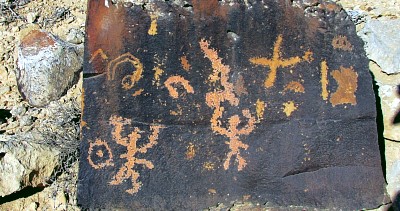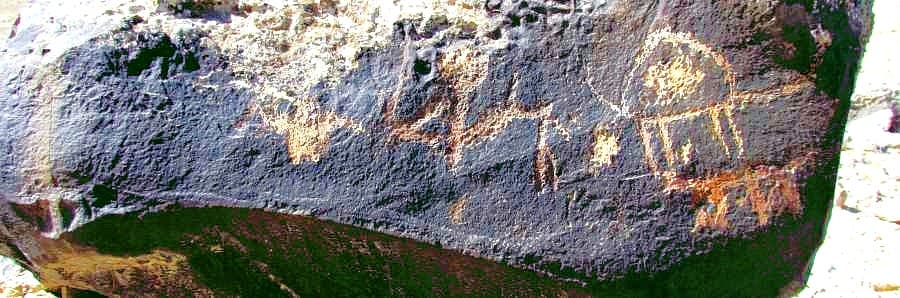
Canaanite Creation myth from the Ugaritic Text, Negev Rock Art
Among the most striking challenges in the study of ancient rock art is the question of intentionality: do the engraved panels of the Negev represent incidental markings, or do they encode a coherent symbolic system reflecting the cosmological beliefs of those who made them? The panel examined here proposes a compelling answer. Far from being a pastoral scene or an accumulation of unrelated signs, the sequence of symbols reads as a visual condensation of the Canaanite creation myth—a narrative whose deep structure is preserved in the Phoenician cosmogony transmitted through Damascius’s De Principiis (Cross 1973; Day 2002; Wyatt 2005; Atherton trans. 1999). At the center of this symbolic grammar stands the cosmic egg, a charged image encapsulating the concentrated potential of pre-created life (Keel & Uehlinger 1998). Analogous motifs distributed across wider Mediterranean contexts suggest not isolated invention but participation in a shared cosmological vocabulary shaped by cross-cultural exchange (Burkert 1992).
The Ancient Text: Damascius and the Phoenician Cosmogony
Any attempt to read cosmological content into the Negev engravings must be anchored in the textual record, however mediated. The most direct point of comparison is the Phoenician creation tradition as preserved by the sixth-century Neoplatonist Damascius, who drew on teachings attributed to the ancient Phoenician sage Mochus. While Damascius writes centuries after the period under consideration, scholars including Cross (1973), Day (2002), and Wyatt (2005) have argued persuasively that his account preserves the outline of genuinely archaic Near Eastern cosmological thought.
“First was the upper air and lower air, these two were the first and from them, God World (Olamos) was created, he was the limit of reason. Saying which, from the merger itself, created Kushar, the God of Wisdom, and then created the egg. .... Kushar is the first step that can be understood and the egg is considered heaven because they say that when it was divided into two halves it created heaven and earth.”
What Damascius describes is a cosmogony of progressive differentiation and divine mediation: chaos resolves into binary opposites (upper and lower air), from which emerges an ordering principle (Olamos), who in turn generates Kushar, the demiurgic craftsman. Kushar’s act of creation produces the egg, and its division into two halves constitutes the final cosmological act—the separation of heaven and earth. This sequential, agent-driven structure is precisely what the rock art panel appears to encode.
Reading the Visual Evidence
To decode the panel, one must first understand the semiotic conventions at work in Negev desert iconography. The engraved symbols may appear abstract at first encounter, but closer analysis reveals a consistent and culturally grounded visual vocabulary. The circle is a particularly instructive case. Rather than carrying a fixed meaning, the circle is polysemous—its significance shifts according to size, placement, and contextual association. Large circles frequently denote celestial bodies, above all the sun, as an emblem of divinity, cosmic order, and sovereign power. Smaller circles, by contrast, evoke the egg: fertility, latent potential, and the threshold of creation (Keel & Uehlinger 1998). A single formal type thus bears multiple semantic registers, a feature characteristic of symbolic systems that demand contextual literacy rather than one-to-one decoding.
Equally significant is the appearance of the Egyptian milk tree motif with its associated “feeding hands” (Fig. 2). This image, rooted in Egyptian iconographic tradition and documented in comparative Near Eastern sources (Pritchard 1969), represents divine sustenance and beneficent cosmic agency. Its presence here, within what appears to be a Canaanite cosmological sequence, is a striking instance of iconographic borrowing and recontextualization—a process well attested in the religious art of the ancient Levant, where Egyptian, Mesopotamian, and local Canaanite visual traditions intersect and hybridize.

Deciphering the Symbolic Sequence
When read against the cosmogonic text, the panel’s four principal symbols resolve into a coherent narrative sequence that precisely mirrors the stages described by Damascius. The first symbol encodes the primordial division of air into upper and lower realms: a wavy line cleaving space into two differentiated cosmic zones, the originary separation from which all subsequent creation flows. This is cosmogony’s first act—the imposition of distinction upon undifferentiated chaos.
The second symbol represents Olamos, the “God World,” the ordering principle that emerges from that primary division. Significantly, this deity is rendered through the iconographic form of the Egyptian milk tree with its nurturing “feeding hands”—symbols of divine sustenance and benevolent cosmic governance (Keel & Uehlinger 1998; Pritchard 1969). The borrowing of an Egyptian motif to represent a Canaanite deity reveals the visual syncretism characteristic of Levantine religious art and attests to the cultural sophistication of the panel’s author.
The third symbol identifies Kushar, the craftsman god of wisdom whose demiurgic intelligence gives form to the cosmos. As a figure known from the Ugaritic texts and related traditions (Wyatt 2005), Kushar represents the transition from cosmic principle to creative act—the moment at which the universe becomes not merely ordered but made. His presence in the sequence is indispensable: without Kushar, there is ordering but no making; without making, the egg—and thus the world—cannot come into being.
The fourth symbol is the cosmic egg itself, the concentrated vessel of creation’s potential. In the Damascian account and the broader Near Eastern cosmological tradition, the egg is not merely a symbol of fertility but a structural element of the cosmos: it is heaven before heaven exists, a bounded totality awaiting differentiation. When split by Kushar’s act, it yields the tripartite universe—heaven, earth, and underworld—and creation is complete (Damascius, De Principiis; Wyatt 2005). Together, these four symbols do not merely allude to the myth; they enact it, transforming cosmological narrative into a compressed visual grammar of origin and order.
Conclusion
The panel presented here constitutes a remarkable artifact of ancient cosmological thought rendered in stone. Its symbolic sequence—the division of the airs, the emergence of Olamos, the creative agency of Kushar, and the splitting of the cosmic egg into heaven and earth—maps with precision onto the Canaanite creation tradition preserved in Damascius’s account of Phoenician cosmogony. This is not coincidence or generic symbolism: it is a structured, sequential, agent-driven creation narrative expressed in a tight visual grammar. What distinguishes the panel from mere religious iconography is precisely this narrative completeness—the four stages form a closed sequence with a beginning, a middle, and a cosmological resolution.
By situating the panel within the comparative textual and iconographic record (Keel & Uehlinger 1998; Cross 1973; Pritchard 1969; Wyatt 2005; Day 2002), it becomes possible to read it not as a pastoral episode or incidental accumulation of signs, but as a deliberate cosmological statement—evidence that the people of the ancient Negev participated fully in the rich intellectual and religious culture of the Levantine world. The rock itself becomes a medium of theological discourse, and the engraver, a narrator of origins.
Related Reading
Bibliography
Burkert, Walter. The Orientalizing Revolution: Near Eastern Influence on Greek Culture in the Early Archaic Age.
Cross, Frank Moore. Canaanite Myth and Hebrew Epic.
Damascius. De Principiis.
Day, John. Yahweh and the Gods and Goddesses of Canaan.
Keel, Othmar, and Christoph Uehlinger. Gods, Goddesses, and Images of God in Ancient Israel.
Pritchard, James B., ed. Ancient Near Eastern Texts Relating to the Old Testament (ANET).
Wyatt, Nicolas. Myths of Power: A Study of Royal Myth and Ideology in Ugaritic and Biblical Tradition.
© All rights reserved. This material may not be published, broadcast, rewritten, or redistributed in whole or part without the express written permission of negevrockart.co.il
Yehuda Rotblum (2020)