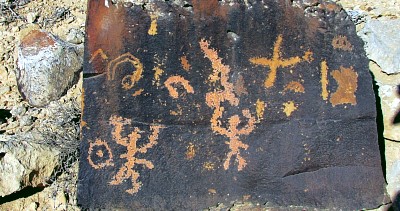
What is Rock Art, and how to read them
The Negev Desert contains one of the largest and least interpreted bodies of rock art in the Near East. Thousands of petroglyphs, engraved over more than two millennia, have long resisted systematic interpretation. The problem is not a shortage of material. It is a shortage of method.
The dominant assumption — that rock art records daily life, hunting, and herding — leaves most of the Negev corpus unexplained. Under that framework, an ibex is a hunted animal and a boat is a boat. But it cannot account for the patterns that a different approach reveals: compositions that repeat across hundreds of panels, structured by the same logic, encoding the same ideas in the same visual language. That silence is the starting point for a different approach.
The Insight That Opened the Corpus
The key for decipherment was geographical. The Negev lay at the intersection of Egypt, Mesopotamia, and Canaan — the dominant powers of the ancient Near East — for centuries. These were not distant influences. They were direct, sustained, and consequential. The great civilisations of the Fertile Crescent shaped the beliefs of the people who lived here, and that mark is visible in the rock art.
The working hypothesis was: if the Negev engravers were shaped by Egyptian, Mesopotamian, and Canaanite traditions, their work should be readable against the symbolic vocabularies of those traditions — not as copies, but as adaptations. A desert community encoding shared theological content in the spare visual language of stone, far from the temples and workshops of the great civilisations, but thinking with the same cosmological problems. When that hypothesis was tested against the corpus, the engravings began to speak.
Rock Art as a Cosmological Language
The most important reorientation for any reader is this: rock art must be approached as a cosmological language, not a literal record. Recurring motifs — ibex, dogs, birds, boats, twin figures, cruciform signs, lunar crescents — are not isolated images but elements of a structured visual vocabulary. They form compositions that encode mythic narratives and constellation-based frameworks known across the ancient Near East. A language has grammar, and vocabulary; so does this visual system. The task of interpretation is to learn that language well enough to read it.
This means single images cannot be read in isolation. Meaning is relational — it emerges from how elements are combined, sequenced, and positioned in relation to one another. The interpreter who reads each element separately misses everything that the composition, as a whole, is saying.
The Method
An identification is accepted only when three conditions are met: the formal parallel is precise, not merely suggestive; the same reading recurs independently across multiple panels; and astronomical, mythological, and formal lines of argument converge on the same conclusion. Where all three conditions are met, the result is not interpretation but decipherment.
Interpretation proceeds inductively. Patterns identified in one panel are tested against others, and only readings that remain stable across multiple contexts are retained. A reading that explains one image but fails when applied to similar compositions elsewhere is not a valid interpretation of the system. This discipline of cross-panel testing is what allows interpretation to become systematic rather than anecdotal.
Three Things to Know Before Reading a Panel
- Rock art describes a heavenly story. Even when its imagery is drawn from earthly life — animals, hunters, boats — its ultimate referent is mythic or cosmic. The earthly subject is a vehicle, not the message.
- Hunting scenes are cosmic struggles. They encode fertility rituals, seasonal myths, or the cyclical battle between life and death — not records of successful hunts. The governing principle is consistent: all rock art is linked to the heavens, either directly through astronomy or indirectly through myth.
- Rock art is sacred. These engravings belong to the sphere of faith, ritual, and myth. They were made to do cosmological work, and they must be read accordingly.
The Connection to Astronomy
Sky worship is among the most universally attested dimensions of ancient religious expression. The sky was the most reliable ordering system available to pre-modern observers — and rock art is one of the primary media in which that reading was recorded. Dots may denote stars or constellations. Lines and grids suggest attempts to chart the heavens. Zoomorphic motifs — ibex, dog, bird, fish — can correspond to constellation figures whose seasonal appearances marked the turning points of the agricultural year. None of these correspondences should be assumed without evidence; but none should be dismissed without it either.
The Connection to Myth
Before writing, knowledge was transmitted through myth — stories that preserved cultural memory across generations. Rock art translates these narratives into visual form. The relationship is not one of illustration but of parallel transmission: both are media through which the same cosmological content was preserved. The Negev engravers were participants in the great Near Eastern discourse about the structure of the cosmos, expressing its core ideas in the visual language of the desert. In essence, they were translating the myth into a visual medium.
What the Corpus Demonstrates
Read through this framework, the Negev rock art makes three claims that reach beyond the desert itself.
First, that the desert communities of the Negev were genuine participants in the intellectual and religious life of the ancient Near East — not passive recipients of outside influence, but communities that absorbed the great traditions deeply enough to compress them, translate them, and make them their own.
Second, that Bronze Age astronomical and cosmological knowledge was far more widely distributed than literate sources alone suggest. The engravers worked without scribes, without institutions, and without writing — and what they produced in stone is evidence of sustained, accumulated knowledge transmitted across generations.
Third, that the religious history of ancient Israel is not fully contained in the biblical texts. What the desert rock preserves preceded the scripture, shaped the world from which it emerged, and survived every attempt to erase it. The engravings were there before the scripture. They are still there.
Explore the Evidence
Each category below represents a theme that runs across the corpus. The articles listed examine specific panels in detail.
📚 Overview
The engravings of the Negev Desert have resisted interpretation for over a century.
This section introduces the book and the method that finally cracked them open —
along with a practical guide to reading the visual language the engravers used.
The Rock Art that Shook the Earth ·
Rock Art in Israel ·
Deciphering Rock Art ·
Cosmological Rock Art
📚 Fertility
In the ancient Near East, fertility was not a natural condition. It was a theological
achievement that had to be invoked, enacted, and renewed each year. The Negev engravers
recorded the rituals behind it — and the cosmic forces they believed made it possible.
Sacred Marriage Fertility · Fertility Scenes in Rock Art
📚 Mythology
The great myths of Egypt, Canaan, and Mesopotamia travelled with the people who believed them.
These articles identify the myths behind the images, myth by myth and panel by panel.
Ugaritic Baal Cycle · Canaanite Creation Myth · Cosmic Egg Creation · The Divine Twins · Stymphalian Birds Hunt Myth · Footprint in Rock Art
📚 Astronomy
Without writing, without institutions, and without instruments, the Negev engravers
produced astronomical records of startling accuracy. These articles examine how they
tracked the sky — and how the knowledge they accumulated was preserved in stone.
Venus Calendar in Rock Art · Moon Calendar Rock Art · Orion and Eridanus
📚 Sun Journey
Every night, the sun disappeared. Every morning, it returned. For desert communities
who understood the sky as a theological text, this daily event was the cosmos's most
fundamental drama — and they recorded it in the rock.
Solar Journey · Afterlife Ship and Boat · The Ibex Hunt as Solar Transition
📚 Afterlife
What happens to the soul after death? The Negev engravers had a detailed answer,
encoded across multiple panels in a consistent visual language translated into
desert symbols that the community around them could read without a scribe.
Boat / Bird Afterlife Journey · Fish Afterlife Journey · Tri-Finger Birds and the Afterlife · Maze in Rock Art
📚 Seasons
In the desert, the difference between the productive season and the barren one was
the difference between survival and starvation. The engravers mapped the seasonal
calendar in the sky and recorded it in the rock — not as abstract notation,
but as cosmological argument.
Spring in Negev Rock Art · Summer in Negev Rock Art · Winter in Negev Rock Art
📚 Script
Among the engravings are inscriptions — letters, names, and divine titles
cut alongside the cosmological imagery. Some of what they record predates the earliest
biblical texts by centuries. The implications for the religious history of ancient Israel
are significant, and still debated.
God Names YH and EL · God Images in Rock Art
Bibliography
Albright, William F. 1966. The Proto-Sinaitic Inscriptions and their Decipherment. Cambridge, MA: Harvard University Press.
Allen, James P. 2005. The Ancient Egyptian Pyramid Texts. Atlanta: Society of Biblical Literature.
Assmann, Jan. 2005. Death and Salvation in Ancient Egypt. Ithaca: Cornell University Press.
Aveni, Anthony F. 2001. Skywatchers. Austin: University of Texas Press.
Barton, Tamsyn. 1994. Ancient Astrology. London: Routledge.
Belmonte, Juan Antonio, and Josep Lull. 2023. Astronomy of Ancient Egypt: A Cultural Perspective. Cham: Springer.
Bradley, Richard. 2000. An Archaeology of Natural Places. London: Routledge.
Campbell, Joseph. 1949. The Hero with a Thousand Faces. Princeton: Princeton University Press.
Cross, Frank Moore. 1973. Canaanite Myth and Hebrew Epic. Cambridge, MA: Harvard University Press.
Golan, Ariel. 1991. Myth and Symbol: Symbolism in Prehistoric Religions. Cambridge: Cambridge University Press.
Hornung, Erik. 1982. Conceptions of God in Ancient Egypt. Ithaca: Cornell University Press.
Keel, Othmar, and Christoph Uehlinger. 1998. Gods, Goddesses, and Images of God in Ancient Israel. Minneapolis: Fortress Press.
Krupp, E. C. 1997. Skywatchers, Shamans & Kings. New York: John Wiley & Sons.
West, M. L. 2007. Indo-European Poetry and Myth. Oxford: Oxford University Press.
Wyatt, Nicolas. 1998. Religious Texts from Ugarit. Sheffield: Sheffield Academic Press.
Zohar, I., and T. Dayan. 1998. “Animal Exploitation in the Negev.” Journal of Arid Environments.
© All rights reserved. This material may not be published, broadcast, rewritten, or redistributed in whole or part without the express written permission of negevrockart.co.il
Yehuda Rotblum (2020)