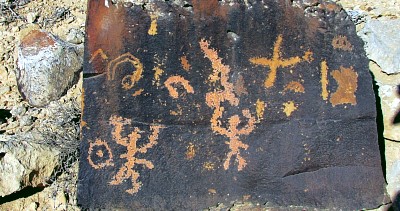
Footprint Engravings: Meaning and Symbolism
Among the more enigmatic motifs in the Negev Desert rock art corpus, the engraved “footprint” has attracted interpretations ranging from territorial markers to votive signs of divine presence. This article proposes a more precise reading: that these paired engravings function not merely as indicators of a god’s passing, but as symbolic gates or thresholds—cosmic portals through which gods and souls transit between the earthly realm, the underworld, and the heavens. The distinction matters. A marker of presence records that something was here; a gate encodes a theology of passage, transition, and the structured relationship between worlds. The formal characteristics of the Negev footprints, their consistent pairing, their asymmetric sizing, and their cross-cultural parallels in Sumerian glyptic art all support the latter interpretation.
These footprint engravings exhibit several distinctive features that recur across multiple sites with remarkable consistency. They are invariably carved in pairs, with one footprint measurably larger than its companion—typically displaying a size differential of 20–30%. Many examples feature protruding “ears” at the heel area, sometimes rendered as simple lines. This formal regularity is not the product of individual improvisation; it reflects a shared and transmitted visual convention with cosmological content. As the comparanda below will show, the asymmetry of size encodes a specific astronomical observation, and the ear-like extensions carry direct iconographic parallels in Sumerian representations of the celestial gate.
The geographic reach of footprint symbolism in ancient rock art suggests a widely shared cosmological tradition rather than an isolated local practice. A compelling example comes from Swedish Bronze Age rock art discussed by Goldhahn (2008), where engraved footprints (Fig. 1) encircle a fire pit associated with burial rites. These footprints are best understood as symbolic gateways to the underworld—thresholds crossed by the soul at the moment of burial, the fire functioning as a ritual hearth that elevates the soul through the gates into the afterlife. The juxtaposition of footprint and funerary fire is not incidental; it is a compositional statement about the mechanics of cosmological passage.

The Heavenly Gate: Astronomical Origins in Mesopotamia
The conceptual origins of the gate motif lie in ancient Mesopotamian astronomy, where the structure of the sky itself was imagined in terms of gates, thresholds, and bounded celestial spaces. John C. Didier (2009) traces this tradition with particular clarity. The “Heavenly Gate” appears on numerous Sumerian cylinder seals as a rectangular celestial configuration (Fig. 2, left image). This rectangle encloses Thuban in the constellation Draco, which served as the pole star between approximately 4000 and 2000 BCE. Ursa Major, conceived as a celestial bull, was imagined as supporting this gate. Together, the surrounding constellations formed a symbolic gateway marking the location of the North Star—the one true constant of the cosmos, the unmoving pivot around which all celestial motion turns.
The cosmological significance of this pole-star gate cannot be overstated. Unlike the rising and setting of other stars, the circumpolar region never disappears below the horizon; it is the sky’s fixed point, the axis mundi in celestial form. To place the gate here was to locate it at the point of maximum cosmic stability—the hinge between the ordered heavens and the world below. What the Sumerian astronomers encoded in their cylinder seals was a precise and sophisticated observation: that the gate to the divine realm stood at the center of the sky’s rotation, accessible only to those who knew where to look.
The Gate in Sumerian Cylinder Seals: Iconographic Analysis
The Akkadian cylinder seal referenced in Fig. 2, dating to approximately 3000–2500 BCE, represents one of the most sophisticated examples of ancient astronomical knowledge preserved in glyptic art. The cylinder seal scene at the center depicts two seated deities, likely Anu and Enlil, holding a cord that passes through the celestial gate, symbolizing their control over cosmic order. The cord represents the constellation Draco, which winds serpent-like between Ursa Major and Ursa Minor. At the center of the gate, upon Draco’s tail, lies the star Thuban.

The gate’s asymmetrical wings carry precise astronomical meaning that directly illuminates the size differential observed in the Negev footprint pairs. The larger right wing represents the eastern rising of stars, while the smaller left wing reflects their western setting. This asymmetry mirrors the ancient observation that celestial bodies appear brighter—and therefore, in a sense, larger—when rising than when setting. The formal inequality of the two wings is thus not decorative variation but a coded record of observed celestial behavior. When the same size differential appears in the Negev footprint pairs, it carries the same astronomical content: the larger footprint marks the gate of rising, the smaller the gate of setting.
The Epic of Gilgamesh, composed around 1800–1500 BCE, provides crucial literary context for understanding these astronomical-mythological connections. The epic’s description of Inanna’s (Ishtar’s) journey through the celestial realm includes specific references to the “Bull of Heaven” and the divine boat that traverses the cosmic ocean separating earth from heaven. In the cylinder seal scene depicted in Fig. 2 (rightmost), Inanna appears as a nude figure stepping through the cosmic gate—a visual representation of the goddess’s ability to travel freely between divine and mortal realms. Her nakedness symbolizes her divine nature transcending earthly constraints, while her direct transition onto the celestial boat emphasizes the gate’s function as a passage between realms. The literary and glyptic traditions reinforce each other: the gate is not merely a pictorial convention but a theologically active threshold.
The “Footprint” Gate in Negev Rock Art: Form and Meaning
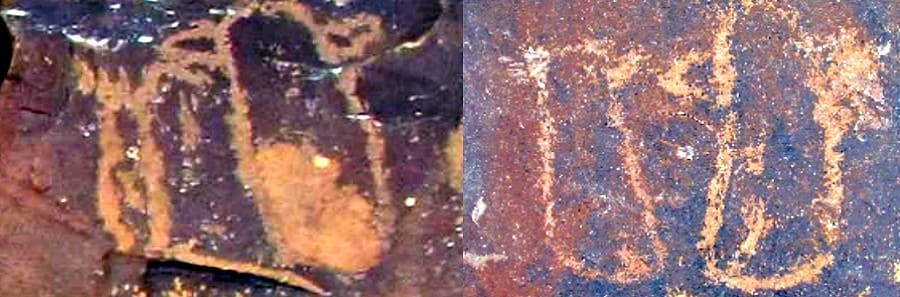
With this Mesopotamian iconographic tradition in view, the formal features of the Negev footprint engravings acquire precise interpretive significance. Fig. 4 illustrates characteristic examples from the Negev Desert corpus. The paired gates are consistently unequal in size, with one measurably larger than the other—echoing the asymmetric wings of the Sumerian celestial gate. Ear-like extensions appear on many examples, directly reminiscent of the winged motifs of the Akkadian cylinder seals; in certain engravings these ears are reduced to simple engraved lines, but the formal reference to the winged gate persists.

The rightmost engraving in Fig. 4 is particularly significant as direct evidence for the gate interpretation. It depicts two sets of footprints arranged in a vertical composition. The upper pair represents the sunrise and sunset gates, with the sun positioned as a complete circle between them—the paired gates framing the solar disc at the horizon. The lower pair symbolizes the moonrise and moonset gates, with the moon situated between them. Crucially, the ratio of the sun’s rising and setting gates maintains the asymmetry observed elsewhere, while the moon gates are equal in size, since lunar luminosity does not vary between rising and setting as solar luminosity does. This internal differentiation within a single engraving is not merely consistent with the gate hypothesis—it constitutes independent evidence for it, demonstrating that the engraver was encoding a precise astronomical observation about the differential appearance of the sun and moon at their respective horizon thresholds.

Fig. 5 extends the range of gate representations to include several distinct celestial actors passing through the threshold. Reading from left to right: Venus enters the gate (as documented in the Venus Calendar); the Venus star hovers above its gates; a double horned ibex with the sun enters the gates; and an ibex enters the gate with half its body inside and half outside. This last image is among the most eloquent in the corpus—the ibex, a symbol of Orion and Osiris as argued on this site, caught in the act of threshold crossing, suspended between two worlds. The gate is not merely a static symbol here but a dynamic passage, and the choice of the ibex as its subject connects the footprint motif directly to the broader celestial theology of the Negev engraving tradition.
The Heavenly Gate and the Circumpolar Sky: Two Galloping Horses
Fig. 6 presents one of the most compositionally ambitious celestial representations in the Negev corpus: two galloping horses carrying a rectangular structure in tandem. The scene represents the northern circumpolar sky, with Ursa Major, Ursa Minor, and Draco (indicated by the upper horse’s tail) arranged around the North Star. This is not a literal portrayal of animals or constellations but an artistic translation of the circumpolar sky into familiar earthly symbols—a cognitive bridge between astronomical observation and visual representation.

The iconographic logic is precise. The kneeling posture of the lower horse is reminiscent of the wheel barrow shape of Ursa Major’s constellation form. The upper horse symbolizes Ursa Minor, while its long tail represents Draco, the constellation that winds between the two constellations. The rectangular area where Draco’s tail crosses marks the location of the North Star, Thuban, from the 4th to the 2nd millennium BCE. The engraver who composed this scene was not simply depicting horses. They were mapping the circumpolar sky in the visual language of their culture, placing the Heavenly Gate exactly where Mesopotamian astronomical tradition located it: at the pivot of the cosmos, carried by the constellations that surround the pole.
Conclusion
The footprint engravings of the Negev Desert are not, as has sometimes been assumed, simple votive marks or territorial signs. Their formal consistency—invariable pairing, systematic size asymmetry, ear-like extensions—reflects a specific and coherent iconographic convention rooted in ancient Mesopotamian astronomical theology. The remarkable convergence between these engravings and the Sumerian cylinder seal tradition, particularly in the asymmetric wing proportions of the Heavenly Gate and the serpentine representation of Draco, provides compelling evidence that sophisticated astronomical knowledge was transmitted across cultures and expressed in locally adapted visual forms.
The internal differentiation within individual panels—solar gates asymmetric, lunar gates equal—demonstrates that the engravers were not copying a received symbol but actively encoding their own astronomical observations within an inherited framework. This is precisely what makes the Negev footprint tradition interpretively significant: it is not mere cultural borrowing, but evidence of a living intellectual practice in which Mesopotamian cosmological concepts were received, understood, and translated into the visual language of the desert.
Related reading
Bibliography
Didier, John C The Ancient Eurasian World and the Celestial Pivot
Goldhahn (2008) In the wake of a voyager. Feet, boats and death rituals in the North European Bronze Age
© All rights reserved. This material may not be published, broadcast, rewritten, or redistributed in whole or part without the express written permission of negevrockart.co.il
Yehuda Rotblum (2020)