Creative calendars following Moon’s cycle, Negev Rock Art
Time, for ancient communities, was not an abstraction. It was a practical problem requiring practical solutions: when to plant, when to harvest, when to hold rituals, when to convene gatherings. In the absence of written records, the sky provided the primary clock, and the moon—with its visible, regular, twenty-nine and a half day cycle—was its most legible hand. But watching the sky requires clear nights, memory, and continuity across generations. What the Negev Desert rock art reveals is a more sophisticated solution: the sky’s rhythms were inscribed in stone, creating permanent, weather-independent instruments that could be operated by placing and removing small markers day by day, regardless of whether the moon was visible (Ruggles 2015).
The Negev Desert, occupying roughly 13,000 square kilometres in southern Israel—approximately sixty percent of the country’s territory—has preserved an exceptional archaeological record precisely because of its aridity. Among its rock engravings are at least three distinct types of lunar calendar, each employing a different counting mechanism, each reflecting both local inventiveness and connections to the broader intellectual world of the ancient Near East. Together they constitute the most diverse body of rock art lunar calendrical evidence known from a single region.
The Deep History of Lunar Counting
Systematic lunar observation is among the oldest documented human intellectual practices. The evidence for deliberate moon-counting stretches back at least 20,000 years, with notched bones and marked objects interpreted as tally systems tracking lunar phases (Marshack 1972). The persistence of this practice across millennia and continents reflects a simple necessity: the lunar month was the most accessible natural unit of medium-range time, visible to anyone and requiring no instruments to observe. Across cultures, the moon became associated with fertility, renewal, and cyclical order—an association whose logic is immediate: the moon disappears and returns, wanes and waxes, dies and is reborn, every twenty-nine and a half days (Aveni 2001).
One of the most carefully studied early examples comes from Lascaux Cave in France (c. 15,000 BCE). Beneath a painted pregnant animal, twenty-eight dots are arranged in a row— widely interpreted as a notation of the lunar month’s visible days (Marshack 1991). The choice of a pregnant animal as the compositional context is deliberate: animal gestation and lunar cycles were linked in the ancient mind as parallel expressions of the same regenerative principle. On the right side, beneath the deer, a square encloses thirteen dots— representing the crescent-moon nights of half the lunar cycle. The count proceeds in both directions to produce twenty-six— the number of days the moon is visible in the sky. The square itself functions as a “rest station”: the marked pause of the moonless days, the gap in the cycle made visible and accountable.

What the Lascaux calendar establishes—and what makes it directly relevant to the Negev material—is a set of principles that recur across the world’s lunar counting traditions: the number twenty-eight as the count of visible days; the square or bounded space as a marker for the moonless period; the integration of fertility symbolism with the counting mechanism; and the use of a visual instrument that could function independently of actual sky observation. The Negev engravers inherited this tradition and adapted it with their own formal inventions.
The Centipede Calendar: Twenty-Eight Legs and the Logic of the Body
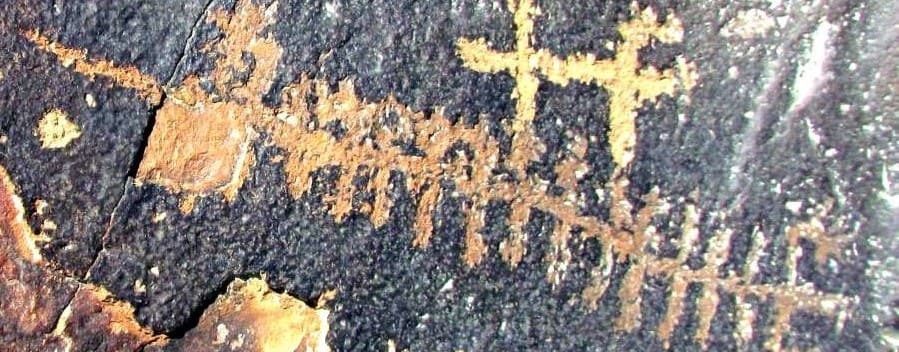
The most visually striking of the Negev lunar calendars is an engraving that takes the form of a centipede (Fig. 2). The creature has precisely twenty-eight legs, each one corresponding to a single visible day of the lunar month, and its body terminates in a square—the same “rest station” device encountered in the Lascaux example, marking the moonless days at the cycle’s close. The parallel is not coincidental. It reflects a shared symbolic logic for encoding the lunar month that persisted across enormous spans of time and geography.

The centipede is a formally elegant solution to the problem of making a tally instrument. A creature whose defining characteristic is the multiplication of legs along a linear body is a natural model for sequential counting: each leg is already a unit, already positioned in order, already part of a series that has a clear beginning and end. The engraver has taken an organism whose morphology is inherently numerical and pressed it into calendrical service. The result is an instrument that communicates its function immediately—even to a viewer who has never seen it before, the sequential structure of the legs implies that they are to be counted.
In operation, the calendar worked through the placement and removal of small stones or markers. Each night, a stone was placed on the next leg, allowing the user to see at a glance how many days of the current cycle had elapsed. The square at the body’s end marked the moment to remove all markers and begin again. Critically, this system functioned on cloudy nights and during periods of poor visibility: the count was maintained in stone regardless of whether the moon could be seen. The instrument did not merely record the sky. It replaced the need for it.
The Sin Calendar: Mesopotamian Theology in Desert Stone
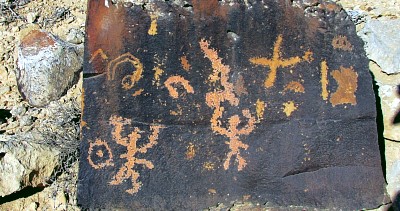
The second Negev lunar calendar (Fig. 3) introduces a dimension absent from the centipede panel: the presence of a divine figure, and with it the explicit theological framing of the counting act. At the centre of the panel sits a figure that closely resembles iconographic depictions of Sin, the Sumerian moon-god, as known from cylinder seals and other Mesopotamian sources—characteristic headdress, seated posture, one hand extended toward a crescent moon above (Black & Green 1998; van der Toorn 1996). Above the figure, fourteen engraved lines are arranged as a tally: stones placed and removed day by day traced the waxing and waning halves of the lunar cycle, each of fourteen days.

The identification of the central figure with Sin is significant beyond iconography. Sin was not merely the Sumerian name for the moon. He was the divine timekeeper of the cosmos—the deity whose movements structured the Mesopotamian calendar, governed the months, and regulated the festivals that organised civic and religious life. His presence in a Negev Desert rock art panel indicates that the calendar depicted here was not a purely local invention but a transmission: the Mesopotamian calendrical tradition, with its theological underpinnings intact, reaching the desert communities of the southern Levant through the networks of trade and cultural exchange that connected them to the wider ancient Near Eastern world.
The dating of the Sin figure to approximately 2500 BCE on the basis of iconographic parallels with cylinder seal depictions provides a chronological anchor for this particular panel—and by association, for the Negev community’s engagement with Mesopotamian astronomical tradition at that period. The figure is not a crude imitation. It is a competent and recognisable rendering of an established iconographic type, suggesting familiarity with Mesopotamian visual culture rather than distant hearsay.
The Star Calendar: Geometry and the Week
The third Negev calendar (Fig. 4) is the most geometrically sophisticated. Two seven-rayed star motifs serve as the counting structure: stones were placed day by day on each successive ray, beginning with the ray positioned beneath an engraved crescent moon. When the first star’s seven rays were filled, counting continued on the second, completing fourteen days—the first half of the lunar cycle. The stones were then removed in reverse order to mark the waning phase, the countdown mirroring the moon’s visual diminishment. The full instrument thus encoded both halves of the cycle, waxing and waning, in a single symmetrical composition.

The choice of the seven-rayed star as the counting unit is not arbitrary. Seven rays on each star produce fourteen positions per star—the exact number of days in a lunar half-cycle—while the seven-day unit itself is the week, the subdivision of the month into four equal parts that is among the most persistent calendrical structures in human history. At the bottom left of the panel, four engraved lines confirm this explicitly: each line denotes one week of seven days, allowing the user to track not only the day within the half-cycle but the week within the month (Kelley & Milone 2011). The star calendar is not merely a counter. It is a structured model of lunar time, articulated at three levels simultaneously: the day, the week, and the half-month.
This same seven-day structure has a long documented history in Mesopotamia. The Babylonian term šapattu named the fifteenth day of the lunar month—the full moon—glossed in cuneiform sources as “the day of the heart’s rest,” a day on which labor ceased. The wider calendar divided the month into seven-day intervals—the 7th, 14th, 21st, and 28th days—tracking the moon’s quarter phases in exactly the structure the Negev star calendar encodes.
The star form also carries its own symbolic resonance. The seven-pointed star is a figure with deep roots in ancient Near Eastern iconography, associated with celestial bodies and divine order. By choosing this form as the counting unit, the engraver has embedded the practical instrument within a cosmological vocabulary: the calendar is not merely useful, it is aligned with the structure of the heavens it tracks.
Conclusion: Three Instruments, One Problem
The three Negev lunar calendars—the centipede, the Sin panel, and the star counter—are formally distinct but functionally unified. Each solves the same practical problem: how to track the lunar month accurately, continuously, and without dependence on direct sky observation. Each does so through a different formal strategy: the centipede through the morphology of a many-legged body; the Sin panel through the authority of a divine figure and a tally above his head; the star calendar through geometric symmetry and the seven-day week. The diversity of solutions to the same problem is itself evidence of active intellectual engagement—of communities that did not simply copy what they inherited but continued to innovate within a shared calendrical tradition.
The Lascaux parallel establishes that the principles underlying all three Negev calendars—twenty-eight visible days, the rest-station for the moonless period, the integration of symbolic form with counting function— belong to a tradition of lunar reckoning that predates these engravings by thousands of years. The Sin panel establishes that Mesopotamian theological and calendrical traditions were present in the Negev by approximately 2500 BCE. Together, the three instruments reveal a community positioned at the intersection of deep prehistoric practice and the advanced astronomical culture of the ancient Near East—receiving, adapting, and extending a tradition of timekeeping whose roots extend to the earliest documented human engagement with the sky (Ruggles 2015; Kelley & Milone 2011).
What the Negev calendars ultimately demonstrate is that the management of time was not a privilege of urban civilisation. Desert communities, without temples or scribal schools, developed instruments of comparable sophistication to those of Mesopotamia and Egypt—instruments that were permanent, teachable, and operable by anyone who knew which leg to mark next, which stone to place on which ray, which line to count. The moon’s cycle was inscribed in the rock, and the rock remembered what the sky sometimes hid.
Related reading
Bibliography
Aveni, Anthony. Skywatchers. University of Texas Press, 2001.
Black, Jeremy & Green, Anthony. Gods, Demons and Symbols of Ancient Mesopotamia. British Museum Press, 1998.
Kelley, David & Milone, Eugene. Exploring Ancient Skies: A Survey of Ancient and Cultural Astronomy. Springer, 2011.
Marshack, Alexander. The Roots of Civilization. McGraw-Hill, 1972; rev. ed. Moyer Bell, 1991.
Ruggles, Clive. Handbook of Archaeoastronomy and Ethnoastronomy. Springer, 2015.
Van der Toorn, Karel. Family Religion in Babylonia, Syria and Israel. Brill, 1996.
© All rights reserved. This material may not be published, broadcast, rewritten, or redistributed in whole or part without the express written permission of negevrockart.co.il
Yehuda Rotblum (2020)