How the Negev Desert engravers tracked the seasons.
Seasonal knowledge is survival knowledge. For the communities of the ancient Negev—pastoralists and agriculturalists operating in one of the most demanding environments in the Levant—knowing when the rains were coming, when to move herds, when to plant and harvest, was not a matter of intellectual curiosity. It was a practical necessity whose failure could be catastrophic. The sky was their most reliable instrument, and among all the celestial guides available to naked-eye observers, few were more legible or dependable than the constellation Boötes.
Boötes and Arcturus: Celestial Behaviour
Boötes is one of the most prominent constellations of the northern sky, visible for the majority of the year from the latitudes of the southern Levant. Its shape—a distinctive kite or elongated pentagon—is immediately recognisable. At its base burns Arcturus, the brightest star in the northern celestial hemisphere and the fourth brightest in the entire night sky.

The key seasonal anchors are the evening rising and evening setting of Arcturus. In early spring, as the sun begins to pull away from the winter sky, Arcturus becomes visible rising just after sunset on the eastern horizon—a signal, in the agricultural calendar of the ancient Levant and Mediterranean, that the winter rains are ending and the grain is ripening toward harvest. In autumn, as Arcturus begins to set in the west in the early evening, the signal reverses: the long dry season is ending, and the first rains, and with them ploughing and sowing, are near. Between these two moments, watched at the same evening hour, the kite changes its posture: lying low in the east in spring, upright high in the sky in summer, and leaning toward the western horizon in autumn.
The Rock Art Panel: Three Poses, Three Seasons
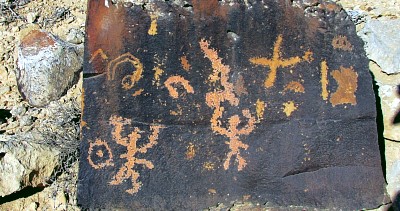
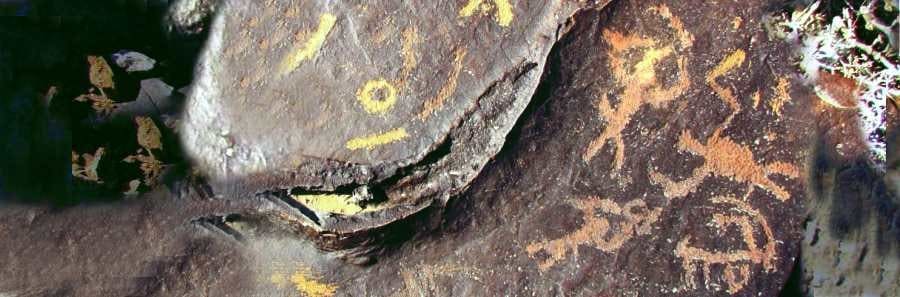
The Negev panel (Fig. 2) translates this astronomy directly into visual form: each of the three figures, arranged in a circle, takes a body posture that corresponds to a different phase of the constellation’s annual cycle. Boötes is identifiable in each figure by the kite shape of its body, with Arcturus symbolised by a dagger hanging from the belt and the raised arms tracing the constellation’s upper stars. The circular arrangement is itself significant: it encodes not a linear sequence but a cycle, a calendar whose end is also its beginning.

The first figure, positioned above the ibex, depicts Boötes in its rising phase: still low in the east, its body lying along the horizon rather than standing. This is the spring pose, signalling that the rains are ending, the harvest is approaching, and the heat is not far behind.
The central figure stands upright at its fullest height, representing Boötes at its Summer Zenith—the moment of maximum elevation in the sky, at the height of the dry season: daylight hours are longest, the heat is at its most severe, the harvest is in, and herds must be kept close to water. The erect posture is the direct visual correlate of the constellation’s highest point in the sky.
The third figure depicts Boötes in its declining phase, leaning toward the western horizon—the constellation’s autumn orientation, as the nights lengthen and the dry season draws to its close, with the first rains and the sowing ahead. Boötes does not simply disappear in autumn: it is seen to descend, and the engraver has captured that descent in the figure’s body.
The Winter Season and the Ibex
During the winter months, the Boötes constellation is absent from the evening sky. The Negev panel addresses this gap with the fourth element of the composition: the ibex, positioned below the spring figure and serving as the winter season marker in the system.
The ibex in the Negev rock art corpus represents the Orion constellation—a well-attested identification in which Orion’s prominent winter visibility in the southern sky corresponds to the ibex’s role as a marker of the rainy season—the months of sowing, growth, and green pasture.
The compositional placement of the ibex below the rising Boötes figure at the threshold between winter and spring encodes the seasonal handoff between the two systems: as the ibex/Orion marker yields, the rising Boötes takes over. The panel does not merely list seasonal markers. It shows them in the correct sequential relationship, the winter marker positioned at the point in the cycle where Boötes re-emerges to resume its seasonal function.
The Spring Equinox: The Lying Pose in Ritual
In another group of panels, Boötes takes the form of a lizard, its kite-shaped body lying down, as the constellation lies along the eastern horizon when it rises. Here the pose marks the spring equinox, when day and night stand equal and the sun’s power begins its rise toward the desert’s own harshest season—the dead heat of summer.
The crossing is marked by the lizard and by Hercules, shown inverted, signalling the coming of that dead season to the desert. Above them, a rider or warrior, armed with a curved spear, attacks a long-necked bird. Below the lizard lies a U-shaped boat derived from the Virgo constellation.

What the scene marks is not a neutral date on a calendar. It marks the passage into the season of the sun’s rising power, the desert’s own dead season of heat and drought. The ritual answers that danger directly: the spear is not aimed at the bird in hostility, but performed to assure that the order of the world—the coming season, however harsh, arriving in its proper turn—will hold. That is the premise of the four-line symbol engraved above: “the year’s rhythm still turning in its proper order.”
Conclusion
The Boötes calendar panel is one of the most functionally explicit astronomical instruments in the Negev rock art corpus. It encodes operational knowledge—a system designed to answer a specific practical question: what season is it, and what should we be doing? The answer is given in the language of positional astronomy, translated into the language of human posture, arranged in a cycle that repeats as reliably as the sky above it.
What the calendar panel demonstrates, finally, is that the Negev engravers were not passive recorders of what they saw. They were system designers—people who understood the annual behaviour of multiple constellations well enough to build a coherent, year-round calendar that required no writing, no counting, and no instruments beyond the ability to find Boötes in the night sky and read its posture.
Related reading
© All rights reserved. This material may not be published, broadcast, rewritten, or redistributed in whole or part without the express written permission of negevrockart.co.il
Yehuda Rotblum (2020, revised 2026)