The Sun's Journey by Ship Egyptian Cosmology
Every morning the sun rises. Every evening it sets. These are the two most predictable events in nature, and yet for the ancient mind they posed the most urgent cosmological question: where does the sun go at night? The answer that Egypt developed over millennia of theological reflection was precise, narrative, and cosmologically complete. The sun does not simply disappear. It descends into the underworld, boards a night vessel, navigates twelve hours of darkness, confronts the serpent of chaos that attempts to halt it, and emerges reborn at dawn. The daily sunrise is not a given. It is an achievement—the outcome of a nightly struggle whose result is never guaranteed until it happens (Hornung 1999; Wilkinson 2003).
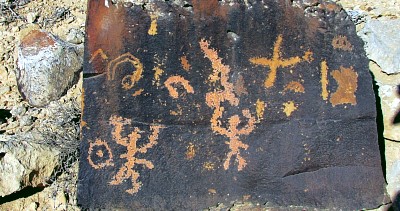
This myth, one of the most elaborately developed cosmological narratives of the ancient world, reached the Negev Desert. Its presence in the rock art engravings of the southern Levant is the subject of this article. The panels discussed here do not merely borrow Egyptian motifs in a general way. They encode specific elements of the solar myth—the twin vessels, the serpent binding them, the cruciform solar sign, the asymmetric gates of dawn and dusk, the three phases of the sun’s identity across its daily arc—with a compositional precision that implies not casual familiarity but sustained engagement with Egyptian cosmological tradition.
The Solar Myth: Egypt’s Cosmological Framework
In Egyptian belief, the sun’s journey was not a single voyage but a structured cycle of two complementary passages. By day, Ra traveled across the visible sky in the mandjet, the Day Barque—the vessel of light, order, and manifest divine power. By night, he transferred to the mesektet, the Night Barque, and descended into the Duat, the underworld through which the sun passed in darkness before its morning re-emergence. The Amduat charts this nocturnal voyage in twelve sections corresponding to the twelve hours of night, each with its own geography, inhabitants, and hazards (Hornung 1999; Allen 2005).
The Coffin Texts articulate the duality of the two vessels with characteristic economy. Spell 335 states: “He sails the sky by day in the bark of millions, and at night he travels through the netherworld in the bark of darkness.” The Book of the Dead (ch. 151) renders the same duality in a striking anatomical metaphor: “Your right eye is the night lightning of the sun boat; your left eye is the daily lightning of the sun boat.” Day and night are not two separate phenomena but two eyes of the same being—the solar cycle made visible as a bodily unity.
The physical form of the solar bark reinforced its cosmological function. Its hull was slender and symmetrically curved at both ends—a form that recalled the swan gliding at the horizon, equally at home in water and in flight. This was not aesthetic preference. It was theological statement: a vessel built to navigate both the celestial and subterranean realms must embody the capacity for both. The solar bark’s shape declared its range before it moved.
At the centre of the night voyage stood the confrontation with Apophis, the chaos serpent whose coils encircled the solar path and whose purpose was to prevent the sun from completing its passage and rising again. The nightly struggle between Ra and Apophis was not a battle between equal forces. It was the fundamental tension of the cosmos—order against chaos, renewal against extinction, the morning light against the permanent night that would result if Apophis ever prevailed. The maintenance of cosmic order, maʿat, depended on Ra’s victory being renewed every night, without exception, for as long as the world endured (Assmann 2001; Frankfort 1948).

The Twin-Ship Panel: Serpent, Sun, and Cosmic Tension
The central panel of this article (Fig. 2) portrays two inverted ships—the day vessel and the night vessel of the Egyptian solar myth—bound together by a wavy serpent that simultaneously attacks the larger ship carrying the sun and tows the smaller vessel through the underworld. The composition is not a loose evocation of Egyptian themes. It is a diagram of the solar myth’s structural logic, rendered in the spare visual language of the Negev corpus.
The inversion of both ships is the first significant formal choice. An inverted vessel in the iconographic vocabulary of the ancient Near East and Indo-European traditions signals the underworld phase of a journey—the vessel turned upside-down as it descends into the dark water beneath the earth. Both ships here are inverted, placing the entire composition within the nocturnal register: this is the night encounter, the Duat passage, the moment of maximum danger and maximum cosmological significance.

The serpent’s role in this composition is more complex than simple antagonism. It crosses the solar path and attacks the larger sun-bearing ship—fulfilling its expected function as the agent of chaos opposing the sun’s passage. But simultaneously it tows the smaller vessel, drawing it through the underworld. The serpent is both enemy and, paradoxically, motive force: the very power that threatens to prevent the sunrise also drives the night vessel forward. This paradox is not confusion in the engraver’s understanding. It is a precise expression of the Egyptian theological insight that chaos and order are not simply opposed but structurally interdependent—that the sun’s nightly confrontation with Apophis is a necessary component of the renewal it produces, not merely an obstacle to it (Assmann 2001).
The sun itself is marked in the composition by a cross— the standard Negev solar sign, derived from the image of a bird in full-spread flight, the extended wings forming the horizontal bar and the body the vertical. Cross equals bird equals sun: a compressed equivalence that the Negev corpus uses consistently. Its presence on the larger ship identifies that vessel unambiguously as the day barque, the carrier of Ra, even within the nocturnal scene of its nighttime ordeal.
The Diurnal Arc: Three Identities of the Sun
Egyptian solar theology did not conceive the sun as a single constant entity that merely moved across the sky. It assigned distinct divine identities to each phase of the diurnal arc, understanding the sun’s day as a theological narrative with three characters: Khepri at dawn, Ra at noon, Atum at dusk. Each identity expressed a different aspect of solar power, and together they constituted not three deities but three faces of one reality—the sun as it became, ruled, and completed.

Khepri, the scarab-headed god of dawn, embodied emergence, self-creation, and the first moment of becoming—the sun rolling itself above the horizon as the scarab rolls its ball of dung across the earth, generating life from apparent nothing. Ra, governing the zenith, represented the sun in its full manifest power: the ordering principle of the cosmos, the foundation of kingship, the source of light and heat at their most intense. Atum, the aged creator of the western horizon, embodied completion and withdrawal—the sun returning to the condition of potentiality from which Khepri would draw it forth again the following dawn (Wilkinson 2003; Frankfort 1948).
The Negev engraving (Fig. 4) translates this three-phase theology into schematic visual form with notable compositional intelligence. A circle—the sun—is connected by a continuous line tracing its arc across the sky. The U-shaped solar barque on the left of the composition provides the vehicle. Two gates mark the boundaries of the visible journey: the rising gate at the eastern horizon and the setting gate at the western horizon. Their difference in rendering is the key to the panel’s meaning.

The rising gate is large, emphatically outlined, and marked by a substantial size—the solar presence announcing itself with force, the moment of Khepri, emergence into the world in full vigour. The setting gate is noticeably smaller, its outline thinner, its size reduced. This asymmetry is not a drafting accident. It encodes the theological distinction between Khepri and Atum: the sunrise is an assertive emergence, the sunset a controlled withdrawal, the same power diminishing toward the threshold of the underworld. The engraver has used the grammar of scale and line weight to express what the Egyptians expressed through iconographic elaboration: the sun does not end its day at the same intensity at which it began it.
Between the two gates, the sun traces its arc through noon—the Ra phase, the moment of maximum potency rendered here simply as the sun at its highest point along the continuous line. The composition does not need to label its phases. The arc itself encodes the narrative: rise, zenith, descent. The three identities are present not as named figures but as positions along a line that both describes and enacts the theology it illustrates.
Conclusion
The two Negev panels discussed here—the twin-ship serpent composition and the diurnal arc with its asymmetric gates—demonstrate something more significant than familiarity with Egyptian solar imagery. They demonstrate understanding of it: the structural logic of the two barques, the paradoxical role of the serpent as both enemy and driver, the three-phase theology of the sun’s daily identity, the formal coding of energy as scale. A viewer who engraved these panels had not merely seen Egyptian motifs. They had absorbed the cosmological argument behind them and found the minimum visual means to re-express it in the Negev’s own schematic register.
The question these panels pose for scholars is not whether Egyptian influence is present—it clearly is—but at what depth it operated. The Negev versions are not copies. They make choices that differ from the Egyptian originals: the serpent’s dual role is foregrounded more starkly here than in most Egyptian representations; the asymmetry of the two gates in Fig. 4 achieves through formal economy what the Egyptians achieved through iconographic elaboration. These are adaptations made by someone thinking with the cosmology, not merely quoting it.
Related reading
Bibliography
Assmann, Jan. 2001. The Search for God in Ancient Egypt. Ithaca: Cornell University Press.
Didier, John C. 2009. In and Outside the Square: The Sky and the Power of Belief in Ancient China and the World, c. 4,500 BC – AD 200. Volume I: The Ancient Eurasian World and the Celestial Pivot. Sino-Platonic Papers 192.
Frankfort, Henri. 1948. Kingship and the Gods: A Study of Ancient Near Eastern Religion as the Integration of Society and Nature. Chicago: University of Chicago Press
Hornung, Erik. 1982. Conceptions of God in Ancient Egypt: The One and the Many. Ithaca: Cornell University Press.
Hornung, Erik. 1999. The Ancient Egyptian Books of the Afterlife. Ithaca: Cornell University Press.
Wilkinson, Richard H. 2003. The Complete Gods and Goddesses of Ancient Egypt. London: Thames & Hudson.
© All rights reserved. This material may not be published, broadcast, rewritten, or redistributed in whole or part without the express written permission of negevrockart.co.il
Yehuda Rotblum (2020)