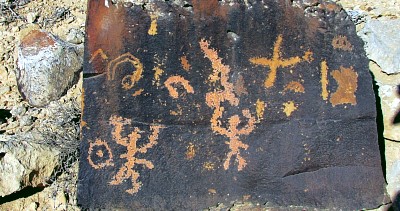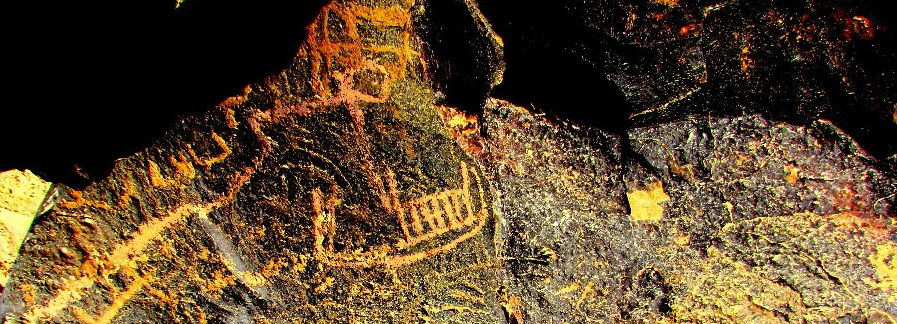
Cosmic vessels: how an inland desert community engraved the sun’s journey, the soul’s passage, and the structure of the afterlife in schematic ships and boats
A ship engraved in desert rock is a deliberate contradiction. There is no navigable water within reach of the Negev engravings; the nearest sea is days of travel distant. Any viewer of these panels, ancient or modern, understands immediately that what is depicted is not a physical vessel on physical water. The ship here is a cosmological symbol, and the water it navigates is the invisible medium of the afterlife—the subterranean ocean through which the sun passes each night and the soul passes at death. To carve a ship in the desert is to make a claim about the structure of the cosmos: that beneath the arid surface lies a sea, and that the sea can be crossed, and that the vessel which crosses it carries both the dead and the dying sun toward the same destination.
This article examines the ship and boat motifs of the Negev Desert rock art corpus—their formal characteristics, their compositional contexts, their parallels in Egyptian, Scandinavian, and broader Near Eastern traditions, and the coherent eschatological theology they collectively express. The Negev vessels are not naive borrowings from maritime cultures. They are precise symbolic instruments, adapted from a shared ancient vocabulary of cosmic navigation to the specific funerary and cosmological concerns of the desert communities that engraved them.
Cross-Cultural Parallels and Solar Cosmology
The ship as a vehicle of cosmic passage is one of the most widely distributed motifs in ancient religious iconography, attested from Egypt to Scandinavia, from the Levant to the Aegean. Its persistence across such diverse cultures reflects not cultural borrowing alone but a shared cosmological logic: the universe is structured by water, and water requires a vessel to cross. The underworld ocean through which the sun descends each night is not merely wet—it is the medium of transformation, the space in which the dead sun becomes the reborn sun, and in which the dead soul becomes the renewed soul (Hornung 1999; Kaul 1998).
In Egyptian funerary religion, this cosmology was rendered with extraordinary precision. The Coffin Texts describe the nightly voyage of the solar bark through the Duat in detail—its route, its crew, its obstacles, and its destination. The full-sized wooden boats buried beside Khufu’s pyramid at Giza were not symbolic gestures. They were functional provisions: real vessels for the pharaoh’s real celestial crossing. That Egypt went to the expense and effort of constructing and burying cedar-wood boats of forty-three metres beside the greatest pyramid in the world indicates how literally the vessel’s cosmological function was understood (Hornung 1999).
Comparable engravings from the Egyptian Eastern and Western Deserts confirm that boat iconography was not confined to the Nile valley—it extended into the arid margins, functioning as part of a broader regional system of afterlife-related imagery in landscape contexts far from navigable water (Huyge 2002; Darnell 2009). Scandinavian Bronze Age rock art adds a further dimension: long vessels with bird-headed prows, conveying processional movement across both water and sky, situate the boat within the same tripartite cosmic structure—underworld, earth, heaven—that governs the Negev material (Kaul 1998; Kristiansen 2010).
The presence of Egyptian symbolic influence in the Negev has a historical context. During the Late Bronze Age, Egypt exercised sustained cultural and political authority over Canaan. The Amarna Letters document the close administrative and diplomatic ties between Canaanite rulers and the Egyptian court. These interactions created channels through which solar symbols, religious concepts, and royal iconography could travel—and almost certainly did—into the symbolic environment in which Negev engravers operated (Moran 1992; Mazar 1992; Redford 1992). The Negev artists were not isolated. They were connected, through the long-distance networks of the Levantine corridor, to the most sophisticated astronomical and funerary traditions of the ancient world.
The Soul’s Celestial Destination
To understand where the Negev vessels are navigating toward, the Egyptian conception of the soul’s celestial destination is essential. Heaven in Egyptian cosmology was not a vague realm of bliss. It was a precise astronomical location: the circumpolar region surrounding the North Star—the only point in the sky that does not rise or set, the one fixed, unchanging place in the nightly rotation. The “Imperishable Stars” that circled this point never descended below the horizon and therefore never died. To reach them was to achieve the same permanence.
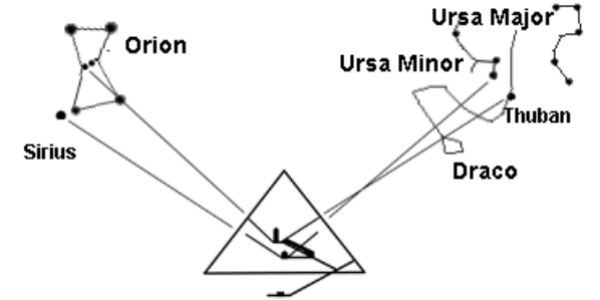
Khufu’s pyramid (Fig. 1) encodes this cosmology in stone. The burial chamber incorporates two pairs of astronomically aligned shafts: the southern shafts point toward Orion, the stellar embodiment of Osiris and the realm of the dead; the northern shafts point toward the circumpolar stars, the location of the eternal heaven (Lehner 1997; Spence 2000). The pyramid is not a tomb in the ordinary sense. It is a launch mechanism, architecturally oriented to project the king’s soul along the precise trajectories required to reach both destinations in sequence: first the underworld of Osiris, then the imperishable stars above. The celestial boat is the vehicle for this journey; the pyramid’s shafts are its departure points.
Ship Motifs in the Negev Desert
Seen through this comparative frame, the vessel engravings of the Negev become legible as a local expression of a widely shared cosmological system. Their inland location, far from any navigable water, does not undermine their significance—it confirms it. Like the boat engravings of the Egyptian desert margins, Negev ship motifs represent ideological and eschatological claims, not maritime experience (Huyge 2002; Darnell 2009). The vessel is present not because the engravers sailed but because the cosmology they inherited required it.
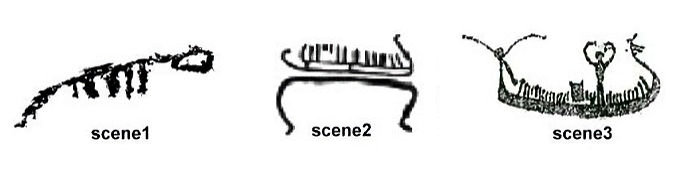
The vertical strokes inside the Negev vessels (Fig. 3, scene 1) represent souls—the “shades of the deceased” in transit (Golan 1991; Zavaroni 2006). This convention—the soul as a vertical stroke within a vessel—is consistent across the Negev corpus and parallels the representation of the dead in comparable traditions. The inverted orientation of the ship in scene 1 is equally deliberate: across Indo-European and Near Eastern traditions, inversion signals liminality—transition, boundary-crossing, and entry into a non-ordinary realm. The inverted vessel is the night ship, the underworld barque, the vessel that navigates in darkness before the dawn that will right it.
The Egyptian Solar Myth in the Negev
The most complex single engraving in the Negev ship corpus (Fig. 4) transposes the Egyptian solar myth into the local visual idiom with a compositional precision that goes beyond general cosmological awareness. According to the myth, Ra traverses the sky by day and descends into the Duat at night, where he confronts Apophis—the chaos serpent—in a struggle whose outcome determines whether the sun rises again. The left image in Fig. 4 shows the Egyptian iconographic template as recorded in a Twenty-First Dynasty depiction; the centre and right images show the Negev engraving and its principal symbols extracted.
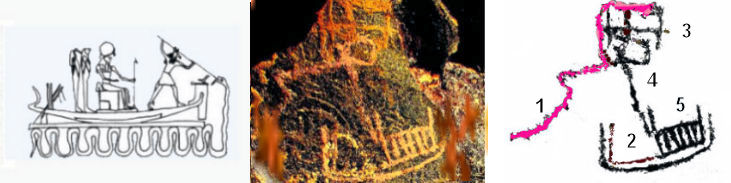
The upper portion of the Negev engraving is partially eroded, but the principal symbols and their compositional logic remain clear. The divine figure (symbol 4)—likely a local deity standing in for or corresponding to Ra— floats within a paired or “double” boat (symbol 2), the same Day Barque and Night Barque duality described in the Book of the Dead as the complementary vessels that carry the sun and soul through the full cosmic cycle. Within the boat: souls in transit (symbol 5) and the cruciform solar emblem (symbol 3)—the sun as a cross, a bird with outstretched wings, the standard Negev solar sign. Coiling around the sun and its enclosing square “house”: the serpent (symbol 1), obstructing the passage, threatening the dawn.
The correspondence with the Egyptian template is not approximate. It is structural—the same agents in the same relationships performing the same functions. What differs is the visual register: where Egyptian funerary art renders these scenes with figural precision and hieroglyphic annotation, the Negev engraver works in a language of minimal signs, reducing each element to its essential form. The serpent is still a serpent; the boat is still a boat; the sun is still the sun. But all are pared to the minimum lines required for recognition. This is not crudeness. It is a different aesthetic tradition expressing the same cosmological understanding.
Boat Types and the Tri-Finger Vessel
Within the Negev corpus, boat motifs are schematic and relatively few in number. Their spare rendering— hull, mast, occasionally prow and stern—emphasises cosmological function over representational detail, in contrast to the elaborate funerary boats of Egypt or the bird-prowed vessels of Scandinavian Bronze Age art. The single vertical stroke that typically appears within the hull likely reflects the individual character of Negev burial practice: one soul, one vessel, one journey.

A distinctive subtype integrates the tri-finger motif into the vessel’s structure—at the prow, stern, or mast (Fig. 6). The tri-finger symbol, derived from the three-toed foot of a bird, encodes the bird’s capacity to traverse all three cosmological realms: underworld, earth, and sky. When placed at the structural points of a boat, it transforms the vessel: this is no longer a craft capable only of water navigation. It is a craft marked by avian agency, capable of crossing both the underworld waters and the celestial expanse above. The bird-foot at the mast is a statement of range—this vessel goes all the way.

The combination of inverted orientation, soul-strokes within the hull, and tri-finger markers at the structural points constitutes the most fully elaborated form of the Negev vessel—a ship whose every feature encodes a stage or aspect of the cosmological journey: the inversion marks the underworld phase; the soul-strokes identify the cargo; the tri-fingers guarantee the guide. The three elements together articulate a complete eschatological programme in minimal visual means.
Conclusion
The ship and boat engravings of the Negev Desert are not anomalies in need of explanation. They are the expected expression of a cosmological system that the Negev engravers shared, in its essential structure, with Egypt, Scandinavia, and the broader ancient Near East. In all these traditions, the vessel is the instrument that makes the afterlife journey possible: it moves through the medium that separates the living from the dead, the earthly from the divine, the setting sun from the rising one. Without the vessel, there is no crossing; without the crossing, there is no dawn and no rebirth. The Negev engravers understood this. They carved it into rock in the driest landscape in the region, because the cosmological argument required it regardless of whether any water was nearby.
What distinguishes the Negev tradition is not its content—which is shared—but its form. The schematic reduction of the vessel to its minimum recognisable elements, the consistent use of the vertical stroke for the soul, the integration of the tri-finger symbol as a guarantee of divine guidance: these are local solutions within a shared vocabulary, the formal choices of a community that had received a cosmological tradition and made it entirely its own. The Negev ships did not cross physical seas. They crossed the space between death and renewal, and they did it in lines spare enough to be cut into desert stone by someone who knew exactly what each mark meant.
Related reading
Bibliography
Darnell, J. C. (2009). “Iconographic Attraction, Iconographic Syntax, and Tableaux of Royal Ritual Power in the Pre- and Proto-Dynastic Rock Inscriptions of the Theban Western Desert.” Archéo-Nil 19: 83–107.
Golan, A. (1991). Myth and Symbol.
Hornung, E. (1999). The Ancient Egyptian Books of the Afterlife. Cornell University Press.
Huyge, D. (2002). “Cosmology, Ideology and Personal Religious Practice in Ancient Egyptian Rock Art.” In Egypt and Nubia: Gifts of the Desert, ed. R. Friedman, 192–206. London: British Museum Press.
Kaul, F. (1998). Ships on Bronzes: A Study in Bronze Age Religion and Iconography. National Museum of Denmark.
Keel, O., & Uehlinger, C. (1998). Gods, Goddesses, and Images of God in Ancient Israel.
Kristiansen, K. (2010). “The Sun Journey in Indo-European Mythology and Bronze Age Rock Art.”
Lankester, F. (2012). “Arms-Raised Figures and the Symbolism of Rebirth.”
Lehner, M. (1997). The Complete Pyramids. Thames & Hudson.
Mazar, A. (1992). Archaeology of the Land of the Bible, 10,000–586 B.C.E. Doubleday.
Moran, W. L. (1992). The Amarna Letters. Johns Hopkins University Press.
Redford, D. B. (1992). Egypt, Canaan, and Israel in Ancient Times. Princeton University Press.
Spence, K. (2000). “Ancient Egyptian Chronology and the Astronomical Orientation of Pyramids.” Nature 408: 320–324.
Zavaroni, A. (2006). “Boat Iconography and the ‘Shades of the Deceased’.”
© All rights reserved. This material may not be published, broadcast, rewritten, or redistributed in whole or part without the express written permission of negevrockart.co.il.
Yehuda Rotblum