The Four-Lines Shalom: A symbol of Wholeness in Negev Rock Art
A cluster of four parallel lines recurs across the Negev rock art corpus with a consistency that is easy to miss on any single panel and impossible to miss once the panels are placed side by side. It is not the most visually striking sign—no curved spear, no horned demon, no galloping horse. It is four short, plain, evenly-spaced strokes. But its very plainness may be the point: this is a mark meant to be added anywhere, attached to almost anything, without competing with the scene it accompanies.
In ancient Near Eastern thought, the four-line symbol—whether depicted as a cross, four rays expanding from a center, or four parallel carved marks—functions as a visual emblem of cosmic order. To the person engraving this symbol, four lines were not decoration and not a count. Four was the number that meant nothing missing:
- the earth still ordered against chaos (Teeter 1997; Faulkner 1969)
- the anchors binding heaven and earth still in place (Wiggermann 2007; Neumann 1977)
- the year's rhythm still turning in its proper order (Cohen 1993)
- a ruler's reach, however far, still whole and unbroken (Seux 1965; Frayne 1993)
To carve four lines was to say the order holding all of this together was whole, and complete. It was a small act of creation in itself—an insistence that the same order which first replaced chaos at the beginning of things still held, unbroken, now.
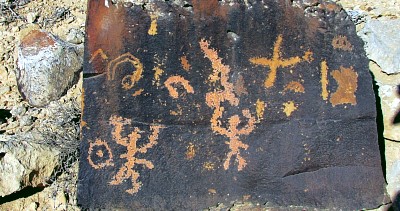
A note on the four principles. This list is a compilation. Its four items come from separate strands of ancient Near Eastern evidence; no ancient source presents them as a set. What grouped them was not a text but a panel: Fig. 1 below, where four signs—each answering to one of the principles named here—are engraved in a single composition, with the four-line mark set apart beside them. The grouping is therefore an inference from the rock art; each of its four members, however, rests on well-attested ancient thought.
And that is what the mark said to whoever found it afterward. Not a wish that things might become whole one day, but a statement that they already were: the desert, the sky, the turning year—still whole, still in order, nothing broken. An observer who saw this symbol was told something plain and steadying: what lies ahead of you is still whole. These are not four separate ideas that happen to share a number. They are one principle, invoked at whatever scale the moment required—closer to the word Shalom than to a simple numeral: not merely "four," but a blessing for the continuation of order and harmony.
Shalom: Wholeness, Not Only Peace
The Hebrew word most often translated "peace"—shalom (שלום)—is built on the root ש.ל.מ (sh-l-m), which describes wholeness (Brown, Driver & Briggs 1906). The English gloss "peace" captures only part of the word's meaning. Its core sense is closer to wholeness, soundness, and intactness than to the mere absence of conflict—a state in which all the parts of something are present and functioning together, intact and undiminished.
This is precisely the sense carried by the traditional Hebrew farewell formula—go in shalom, and return in shalom—used across the Bible (Exodus 4:18; 1 Samuel 1:17; 1 Samuel 20:42). It is a wish that wholeness itself would accompany whatever must depart and return: that the ordered totality of things remain stable wherever you are. A journey is one instance of this—precisely the moment a person leaves the bounded, ordered space of home and enters the unbounded exterior. But the same structure governs the sun's nightly descent into the underworld and its dawn return, and the seasonal cycle that must turn again each year. In every case, it's a wish for continued wholeness.
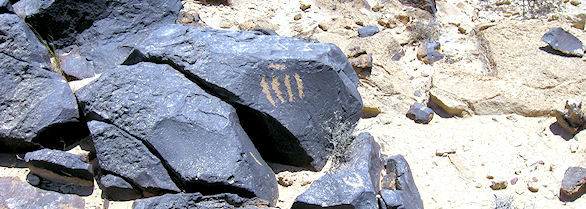
Read against this background, the four-line mark— attached specifically to scenes where continuity is at risk—reads as a visual counterpart to that same formula. And on at least one panel, it appears with no scene at all: stated plainly, on its own, as a standing wish.
The Symbol in Context
The article's opening image demonstrates the symbol's purpose best. On a large, mostly bare rock face, the mark stands entirely alone—nothing else is engraved, with ample room for more engravings. If the sign's meaning depended on whatever it sat beside, this panel would be unreadable. It isn't. A mark that needs no companion to be understood was never borrowing its meaning from its neighbours in the first place. Read this way, the mark was not a blessing tied to any one occasion—not travel specifically, not the sun's crossing specifically—but a general invocation of the four principles, stated once and needing no further context: let order and harmony hold, everywhere, always.
The pattern becomes visible only once the remaining panels are read together. Individually, each is a small, self-contained scene. Collectively, they show the four-line mark attached overwhelmingly to images of continuity under threat—a crossing, a cycle, a departure—or to the specific event, solar, afterlife, journey, whose entire symbolic function is to accomplish the change safely from one state to another.

Fig. 1 is the only known panel in this corpus where all four principles appear together. Four signs, crowded onto it, spell out the principles already named: (1- cross ): the earth still ordered against chaos. (2- circle fused with the cross): the anchors are in place, the order of heaven and earth holds. (3- cross): the year's rhythm still turning in its proper order (4- the raptor bird above): the ruler's reach, however far, still holds—the same claim Naram-Sin of Akkad made when he took the title King of the Four Quarters, c. 2254–2218 BCE (Frayne 1993; Foster 2016). The four-line symbol accompanies none of these signs—it stands apart from the scene. Its mere presence in the composition is itself enough to state that the order, with all its parts, holds.
That an engraver could gather all four signs into one deliberate composition, and set the four-line mark apart from them as if to summarize what they state together, argues for real command of the idea behind the symbol—not a copied form whose meaning had already been lost. The audience was familiar with the idea too—they understood it and practiced it, as attested by its recurrence across many rock art scenes.
What recurs instead, across the panels that follow, is a different and complementary pattern: each pairs the four-line mark with only one of the four signs, standing for that single principle alone.

In Fig. 2, the four lines sit beside a plain cross and a rotational, hook-armed cross—a motif attested widely across ancient rock art traditions and generally read as a solar-motion sign, the sun's turning rendered as a turning cross. Both companions belong to the same solar register already established throughout this site's broader corpus, where the cross repeatedly encodes the sun itself—together they form one compound sign, not two separate ones, and this panel accordingly names a single principle: the rhythm of time itself—the year's motion still turning in its proper order.

In Fig. 3 the sun is fused with a cross, as in sign 2 of Fig. 1, and set beside the four lines. This panel names a second principle in isolation, the sharpest single instance of the pattern: the anchors are in place, the order of heaven and earth holds.

Fig. 4 shifts from the sun's renewal to a boat's crossing. The inverted orientation matches a convention already documented on this site—inversion marking a night vessel, the vessel that navigates the underworld crossing in darkness. Here the sun and the boat appear together, with the four lines positioned between them, as if addressing both vehicles of the same nocturnal passage at once. Heaven's sign and earth's vessel, held together here by the same structural promise.

Fig. 5 reduces the composition to its two essential elements—the mark and the inverted boat—stacked directly above one another, with no other sign competing for attention. The message it wishes is a successful crossing through the underworld, be it for the sun or a soul.

Fig. 6 amplifies the request for wholeness by engraving four sets of four lines, each paired with a rotating wind symbol—generally read as a solar-wind sign. Repetition as intensification of a plea or blessing shows up across a huge range of ritual traditions: here, multiplying the mark is a request from the engraver to assure or "square" the order and harmony that already exist. The squared arrangement is fitting—each principle is inferred, and the repetition engulfs all of it.

Fig. 7 departs from the solar and renewal register entirely, and in doing so it extends the pattern rather than breaking it. A camel convoy is the most literal journey available to a desert community—an actual caravan, not a mythological vehicle standing in for one. That the four-line mark accompanies this scene too confirms its meaning was never confined to cosmological cycles alone: a journey across the desert carries the same uncertainty, the same need for a plea of safe return.

Fig. 8 is a deciphered rock art scene — see half-year — that assures the fulfillment of the third principle: the year's rhythm still turning in its proper order. It affirms the year's order at the sun's transition into the spring equinox. At this point, the sun's power begins to intensify, announcing that the desert's dead season has arrived. That it will arrive in its proper turn is assured — the four-line symbol engraved above confirms it.
Conclusion
All across the panels above, the symbol describes a short, recurring list of events: a sun that must return, a boat that must cross, a cycle that must renew, a caravan that must arrive—each something that could fail to happen, and needed reassurance.
Read individually, "four" is a number with a long history across the ancient Near East, prevalent in cultures like Mesopotamia, Egypt, and Canaan—well-attested as ancient shorthand for totality and cosmic order. Read as a group, these rock art panels suggest something more specific than that general association: a mark invoked wherever continuity could not be taken for granted, and—on the one panel where it stands alone—invoked with no occasion at all, as a standing wish rather than an occasional one. It is the visual equivalent of the Hebrew farewell—go in shalom, return in shalom—not tied to any single journey, but a standing assurance that wholeness holds.
Read as a group they also amount to more than the reading of a single sign. They are a set of thoughts that circulated in the region and went unrecorded in writing—preserved instead in the rock. Applied to the panels they work as a key: scenes that had resisted reading resolve once the mark is understood as invoking order at whatever scale the panel concerns.
Where the Four Comes From
The four is not an abstract number applied to the world after the fact; it is read off the horizon. Mesopotamian directions were framed around four principal winds rather than compass points—the Akkadian word for a cardinal direction is the word for wind—and the four winds are attested in Sumer before 3000 BCE, earlier than any royal title or surviving cosmological text (Neumann 1977; Wiggermann 2007). The sun supplied the other axis: its rising and setting points at the equinoxes and solstices were used to fix direction by horizon alignment. Confirming that the two wind axes and the two solar points still stood where they belonged on the skyline was all it took to say that order held in the land.
Each of the four principles builds on that observation, each one step further from it than the one before:
- The earth still ordered against chaos is the observation itself given meaning. To quarter the world is already to order it: four directions bound the created, inhabited earth, and what chaos threatens is precisely that bounding (Teeter 1997; Faulkner 1969).
- The anchors binding heaven and earth give that order a structure: a quartered earth has four corners, and the sky above it needs four supports—the Sumerian earth conceived as a four-cornered field (Horowitz 1998), the Egyptian sky held at each corner by a pillar, identified with the four sons of Horus and the pillars of Shu (Faulkner 1969).
- The year's rhythm still turning in its proper order turns the same structure from space to time: the solar points that fix direction on the skyline also mark the year's turns (Cohen 1993).
- A ruler's reach, however far, still whole and unbroken is the latest and most derivative of the four: the title King of the Four Quarters enters Mesopotamian usage with the Akkadian empire in the twenty-third century BCE (Seux 1965; Frayne 1993), a political claim staked on a cosmology already in place.
Only at the end of this sequence does four become a symbol of completeness. In Egypt it became the commonest sign of totality by way of its association with the cardinal directions (Wilkinson 1994): four means all of it because four directions leave nothing out. This settles a question for the Negev. An order read off the sun and the winds needs no transmission from Sumer or Egypt; the desert supplies the same four to every observer who watches it, and the engravers of these panels needed no borrowed doctrine to arrive at a fourfold mark.
Related reading
Bibliography
Brown, F., Driver, S. R., & Briggs, C. A. (1906) A Hebrew and English Lexicon of the Old Testament. Oxford: Clarendon Press. (entries שלום / shalom, שלם / shalem).
Cohen, M. E. (1993) The Cultic Calendars of the Ancient Near East. Bethesda: CDL Press.
Faulkner, R. O., trans. (1969) The Ancient Egyptian Pyramid Texts. Oxford: Clarendon Press.
Foster, B. R. (2016) The Age of Agade: Inventing Empire in Ancient Mesopotamia. London: Routledge.
Frayne, D. (1993) Sargonic and Gutian Periods (2334–2113 BC). The Royal Inscriptions of Mesopotamia, Early Periods, vol. 2. Toronto: University of Toronto Press.
Horowitz, W. (1998) Mesopotamian Cosmic Geography. Winona Lake: Eisenbrauns.
Neumann, J. (1977) 'The Winds in the World of the Ancient Mesopotamian Civilizations', Bulletin of the American Meteorological Society 58, 1050–1055.
Pritchard, J. B., ed. (1969) Ancient Near Eastern Texts Relating to the Old Testament, 3rd ed. Princeton: Princeton University Press. (pp. 240, 257, 374).
Seux, M.-J. (1965) 'Les titres royaux šar kiššati et šar kibrāt arba'i', Revue d'Assyriologie 59, 1–18.
Teeter, E. (1997) The Presentation of Maat: Ritual and Legitimacy in Ancient Egypt. Chicago: Oriental Institute of the University of Chicago.
Wiggermann, F. A. M. (2007) 'The Four Winds and the Origins of Pazuzu', in C. Wilcke (ed.) Das geistige Erfassen der Welt im Alten Orient. Wiesbaden: Harrassowitz.
Wilkinson, R. H. (1994) Symbol and Magic in Egyptian Art. London: Thames & Hudson.
© All rights reserved. This material may not be published, broadcast, rewritten, or redistributed in whole or part without the express written permission of negevrockart.co.il
Yehuda Rotblum (2026)